On the Saturday after Thanksgiving 2025, the day known as Small Business Saturday, 63.0 million Americans shopped online and 62.7 million shopped in stores, according to the National Retail Federation. A year earlier, stores led by more than 7 million people.
This year’s Small Business Saturday falls on November 28, 2026. A Cirqley analysis of Small Business Administration data for all 50 states and the District of Columbia shows why the shift online matters so much: most small businesses have no staff at all, so their website and listings are often the only shop window open.
Key findings
- On the Saturday after Thanksgiving 2025, online shoppers outnumbered in-store shoppers, 63.0 million to 62.7 million (NRF).
- Online shoppers that Saturday rose about 17% in a year, from 53.9 million. In-store shoppers rose about 3%, from 61.1 million.
- About 82% of U.S. small businesses have no paid employees, according to a Cirqley analysis of SBA state profiles.
- In 29 states, more than 80% of small businesses have no paid employees. Tennessee and Texas lead at 86%.
- Retail, restaurants and lodging account for about 23% of small business jobs nationally, from 29% in Montana to 17% in the District of Columbia.
- Washington has 695,695 small businesses. About 77% have no paid employees, the fifth-lowest share in the country.
Is Small Business Saturday still an in-store day?
Not by headcount. On the Saturday after Thanksgiving 2025, NRF counted 63.0 million online shoppers and 62.7 million in-store shoppers. In 2024 the order was reversed: 61.1 million in stores and 53.9 million online.
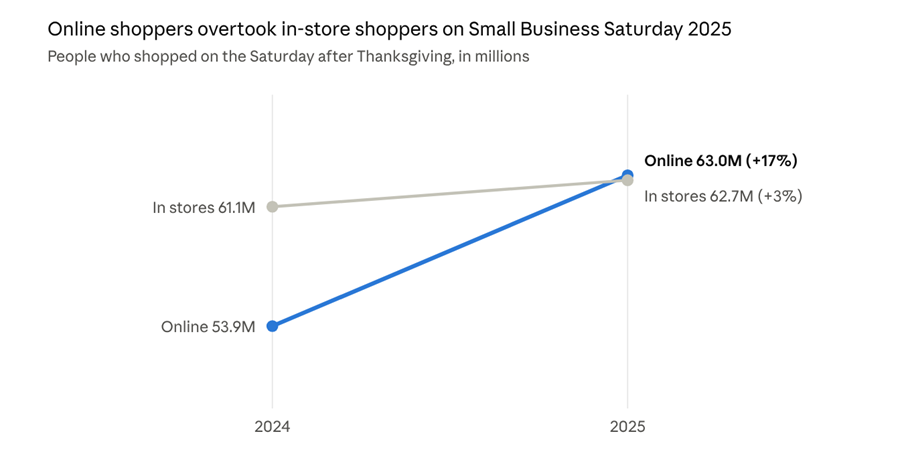
In-store shopping did not fall; it grew about 3%. Online shopping grew about 17%, which is why it pulled ahead. NRF’s count includes everyone who shopped that Saturday, not only people who bought from small businesses, but it shows where shoppers’ attention went.
Sales data points the same way. In November 2025, daily sales at nonstore retailers, the Census category that includes online sellers, ran about 13% above an average day for the year, while retail overall ran about 3% above, according to a Cirqley analysis of Census Monthly Retail Trade data.
Do shoppers still want to support local businesses?
Yes, and that intent is strong. In its forecast for the 2025 weekend, NRF found that 67 million people were potential shoppers on the Saturday after Thanksgiving, and 80% of them were considering shopping to support local businesses and Small Business Saturday.
The gap is in how they shop. The goodwill is there, but a growing share of it reaches businesses through a screen. Shoppers who want to buy locally still have to find the business, check that it is open and see what it sells, often from a phone, before they decide whether to visit.
The weekend is also spreading out. In 2025, in-store shoppers on the Sunday after Thanksgiving rose 27% to 32.6 million, and Cyber Monday drew 75.9 million online shoppers, up from 64.4 million, according to NRF. For a small business, Saturday is one day in a four-day window. An offer that runs from Friday to Monday reaches shoppers who do not plan around a single date.
Editor note (remove before publishing): NRF usually releases its Thanksgiving weekend forecast about a week before the holiday. Add the 2026 figures here on publish day and compare them with the 2025 actuals.
Why does the online shift matter so much to small businesses?
Because most small businesses have no one else to mind. Of the roughly 36.3 million small businesses counted in the SBA’s 2025 state profiles, about 82% have no paid employees. The owner is the whole staff.
The share is high everywhere, but it varies. In 29 states it is above 80%. It is highest in Tennessee and Texas (86%), then Georgia, Mississippi and Florida (85%). It is lowest in Montana (75%), North Dakota (76%), South Dakota (76%), Wyoming (77%) and Washington (77%).
This matters on a day like Small Business Saturday. An owner who works alone cannot serve customers at the counter, answer the phone and reply to messages at the same time. When shoppers check online first, a clear website, correct hours and an easy way to order or book do the work a second employee would.
Is Small Business Saturday only for shops?
No. Retail, restaurants and lodging account for about 23% of small business jobs nationally, according to a Cirqley analysis of the same SBA profiles. The other 77% are in industries that rarely appear in Small Business Saturday campaigns. In Washington, for example, health care, construction and professional services each employ more small business workers than retail does.
That share ranges from 29% in Montana, 28% in Mississippi and 28% in Hawaii, to 17% in the District of Columbia and 20% in Maryland and New Jersey. In states at the top of that range, the day reaches a larger part of the small business economy. Everywhere else, service businesses have room to take part in ways shoppers do not expect.
What does Small Business Saturday look like in Washington?
Washington has 695,695 small businesses, and they employ 48.7% of the state’s employees, according to the SBA’s 2025 Washington profile. About 77% have no paid employees, the fifth-lowest share in the country. Washington’s small businesses are a little more likely than most to have staff.
They are also driving growth. From March 2023 to March 2024, small businesses added a net 27,671 jobs in Washington, 70.4% of the state’s net job gain.
Retail, restaurants and lodging make up about 23% of small business jobs in Washington, in line with the national share.
Retail is not where most of those jobs are. The five industries with the most small business workers in Washington are:
- Health care and social assistance: 199,949
- Accommodation and food services: 193,671
- Construction: 184,579
- Professional, scientific and technical services: 138,907
- Retail trade: 134,179
For a Seattle dental practice, a Spokane contractor or a Tacoma accounting firm, Small Business Saturday is not a sales day in the usual sense. It is a day when people are thinking about local businesses, and a business with a gift card, a seasonal offer or open December bookings can be part of that.
Small business numbers for every state
Find your state below. Small businesses are firms with fewer than 500 employees, as the SBA defines them; figures are from the SBA’s 2025 state profiles, which use 2022 Census data. The last two columns are Cirqley calculations from those profiles.
| State | Small businesses | Share of employees at small businesses | Share with no paid employees | Share of small business jobs in retail, restaurants and lodging |
| Alabama | 465,610 | 46.0% | 84% | 24% |
| Alaska | 77,814 | 54.2% | 78% | 25% |
| Arizona | 706,640 | 42.6% | 83% | 22% |
| Arkansas | 292,728 | 46.1% | 83% | 25% |
| California | 4,340,784 | 47.4% | 81% | 23% |
| Colorado | 730,887 | 48.6% | 80% | 23% |
| Connecticut | 381,129 | 48.1% | 82% | 22% |
| Delaware | 111,346 | 50.6% | 80% | 24% |
| District of Columbia | 82,666 | 49.1% | 79% | 17% |
| Florida | 3,485,976 | 39.6% | 85% | 24% |
| Georgia | 1,374,972 | 42.5% | 85% | 24% |
| Hawaii | 144,375 | 49.6% | 83% | 28% |
| Idaho | 207,670 | 56.0% | 77% | 24% |
| Illinois | 1,353,957 | 43.7% | 81% | 21% |
| Indiana | 591,671 | 43.2% | 81% | 22% |
| Iowa | 289,962 | 46.0% | 79% | 22% |
| Kansas | 273,419 | 48.9% | 79% | 21% |
| Kentucky | 393,860 | 42.6% | 83% | 25% |
| Louisiana | 511,235 | 54.1% | 84% | 24% |
| Maine | 160,215 | 54.5% | 79% | 26% |
| Maryland | 696,710 | 47.9% | 84% | 20% |
| Massachusetts | 756,096 | 44.7% | 81% | 21% |
| Michigan | 983,079 | 47.7% | 82% | 23% |
| Minnesota | 560,428 | 45.8% | 79% | 20% |
| Mississippi | 294,768 | 47.0% | 85% | 28% |
| Missouri | 590,131 | 44.4% | 81% | 23% |
| Montana | 141,011 | 66.3% | 75% | 29% |
| Nebraska | 193,495 | 47.5% | 78% | 22% |
| Nevada | 353,621 | 45.0% | 83% | 26% |
| New Hampshire | 145,314 | 50.3% | 79% | 24% |
| New Jersey | 1,051,630 | 48.8% | 81% | 20% |
| New Mexico | 172,113 | 53.3% | 81% | 26% |
| New York | 2,378,996 | 46.6% | 81% | 23% |
| North Carolina | 1,107,537 | 44.2% | 83% | 24% |
| North Dakota | 78,219 | 57.6% | 76% | 25% |
| Ohio | 1,081,292 | 43.8% | 83% | 22% |
| Oklahoma | 395,520 | 50.8% | 82% | 24% |
| Oregon | 417,747 | 53.4% | 77% | 24% |
| Pennsylvania | 1,169,008 | 45.2% | 80% | 21% |
| Rhode Island | 116,149 | 51.1% | 80% | 25% |
| South Carolina | 530,402 | 42.9% | 83% | 27% |
| South Dakota | 96,770 | 58.0% | 76% | 27% |
| Tennessee | 741,196 | 41.5% | 86% | 24% |
| Texas | 3,517,343 | 44.4% | 86% | 22% |
| Utah | 371,569 | 45.4% | 79% | 22% |
| Vermont | 81,949 | 62.1% | 79% | 26% |
| Virginia | 880,366 | 45.9% | 82% | 21% |
| Washington | 695,695 | 48.7% | 77% | 23% |
| West Virginia | 118,045 | 47.4% | 79% | 25% |
| Wisconsin | 497,370 | 48.0% | 78% | 22% |
| Wyoming | 81,924 | 65.2% | 77% | 27% |
Source: SBA Office of Advocacy, 2025 Small Business Profiles for the States; Cirqley analysis.
What should a small business have ready by November 28?
The data points to one priority: be easy to find and easy to buy from online, even if the sale happens in person. Six steps, in order:
- Check your hours everywhere this week. Update your website, business profiles and any booking pages for Thanksgiving, November 26, through Sunday, November 29. A shopper who sees “closed” on a listing will not call to double-check.
- Give online visitors something to do. A shop can offer “order online, pick up in store.” A restaurant can take reservations or gift card orders. A service business can sell gift cards or prepaid sessions, or open December bookings.
- Make your offer findable. Put your Small Business Saturday offer on your homepage and in your profile posts, using the words customers search for, such as “gift card” or “open Saturday.” Simple, clear search visibility matters more than a clever slogan.
- Tell your regulars first. Send one email or text, and make one social post, three to five days before, and run the offer from Friday to Monday. Say what you offer, your hours, and how to buy without visiting.
- Keep any ads small and local. If you advertise, target a short radius around your business for the weekend only. Some categories, such as health care and legal services, face ad platform restrictions, so check them before you launch.
- Follow up the week after. Thank new customers and invite honest reviews. Do not offer anything in exchange for positive reviews: the FTC’s rule on consumer reviews bans buying reviews that express a particular sentiment.
Not sure where your business stands?
Businesses unsure whether their website, listings and ads are ready for the holiday weekend can ask Cirqley for a marketing evaluation.
Methodology
Shopper counts are from NRF’s Thanksgiving weekend surveys with Prosper Insights & Analytics (3,099 adults surveyed November 26 to 30, 2025, for the actuals; 8,000 adults surveyed October 31 to November 6, 2025, for the forecast). NRF counts everyone who shopped on the Saturday after Thanksgiving, not only those who shopped at small businesses. State figures come from the SBA Office of Advocacy’s 2025 state profiles (2022 Census data) for all 50 states and the District of Columbia; Cirqley calculated the no-paid-employee share as nonemployer businesses divided by all small businesses, and the retail, restaurant and lodging share as small business employees in retail trade plus accommodation and food services, divided by all small business employees. National shares add up the 51 profiles. All sources were accessed November 5, 2026.
Media note
Journalists may use these figures with a link to this page.