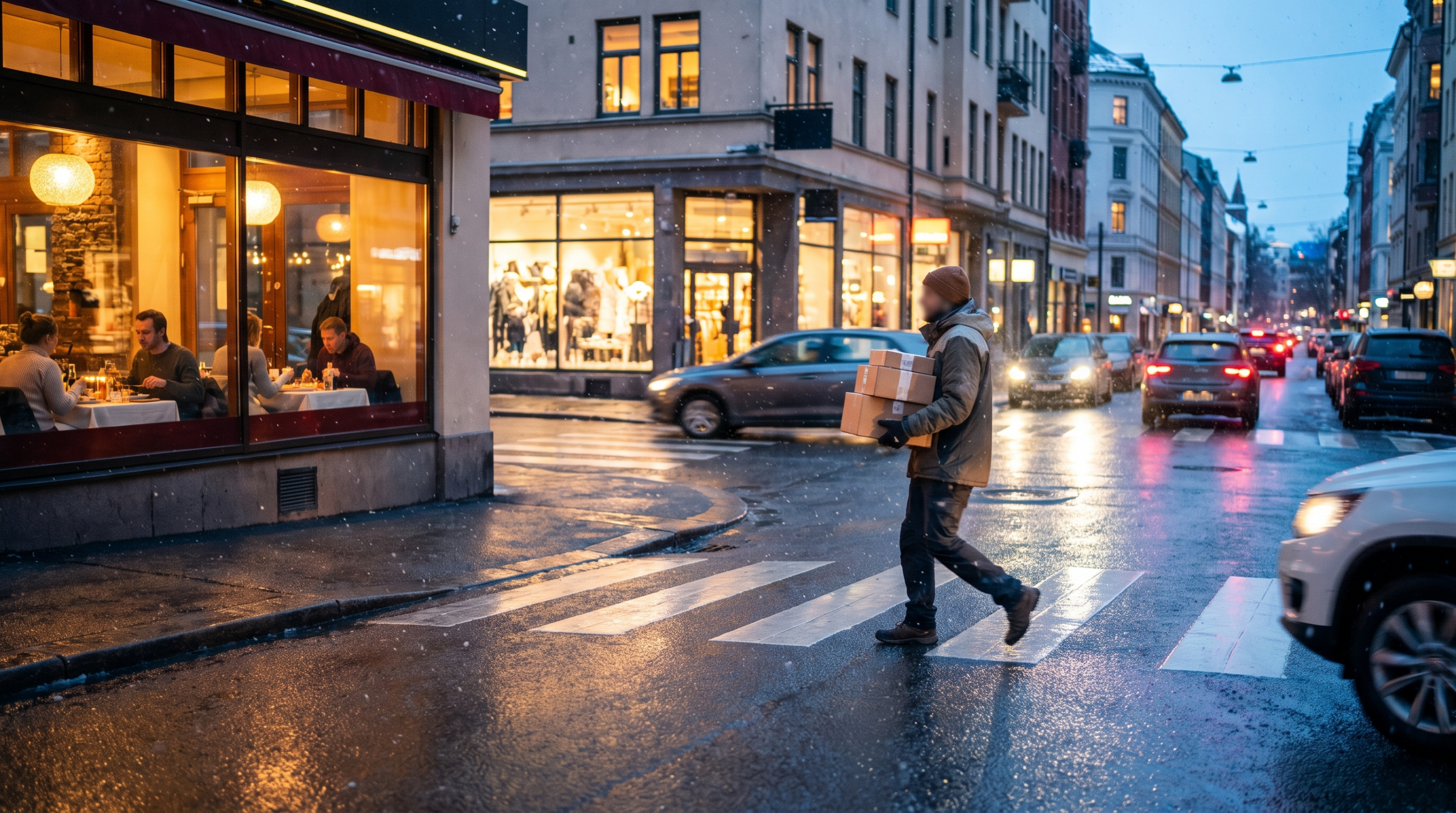
Not every business gets busy at the same time in winter. Online sellers are busiest in December. Restaurants have their slowest month in January. Flu season most often peaks in February. December is also a deadly month for drunk-driving crashes. And heating calls follow the weather, which this year is expected to be much colder.
So the real question is when your customers will show up. Plan for the wrong month, and you spend money when no one is looking and go quiet when they are.
This article reads public data for five industries: retail, restaurants and hospitality, personal injury law, health and wellness, and home services. For each one, it shows when demand moves, what that means, and one step to take now.

The season in brief
- Retail: December is the peak, especially for online sellers. January is the drop to plan for.
- Restaurants: December is close to an ordinary month. The real winter story is the January slowdown and a few big event days.
- Personal injury law: alcohol-impaired crash deaths remain a December pattern, and people need help when offices are closed.
- Health and wellness: year-end benefit deadlines push demand into December; flu season most often peaks in February.
- Home services: this winter’s heating costs and weather vary sharply by fuel and region.
When does each industry peak?
Retail and restaurants are the two industries measured in monthly sales. The chart uses U.S. Census Bureau Monthly Retail Trade data for all of 2025 (retail, nonstore retailers, and restaurants and bars), so winter can be seen against the rest of the year.
Each point compares a month’s daily sales with an average day, so short and long months are compared fairly.
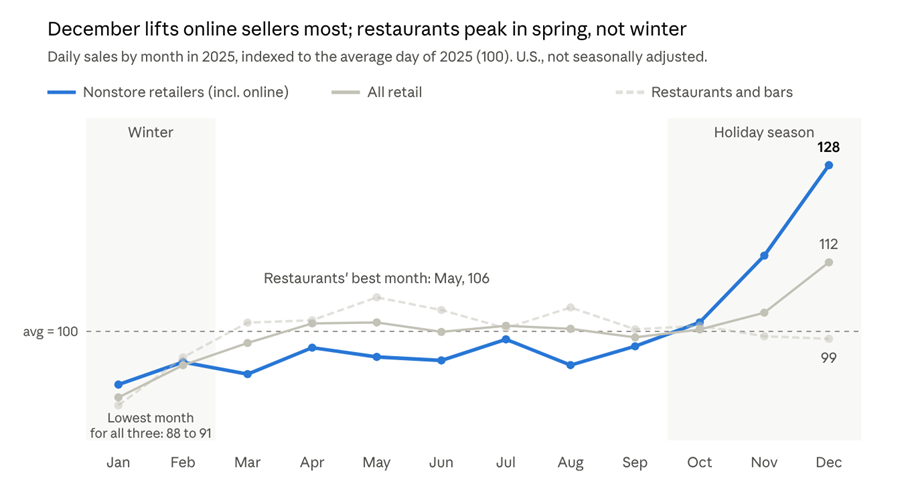
Three patterns stand out. December is the only month far above average for retail, and online sellers rise furthest. January is the weakest month of the year for all three. Restaurants have no winter peak at all: their best month was May.
For the other three industries, the clock is set by something other than shopping:
- Personal injury law: NHTSA counted 934 deaths in alcohol-impaired-driving crashes in December 2024, and its holiday enforcement campaign runs December 16 to January 1.
- Health and wellness: unused health FSA money on calendar-year plans is largely lost after December 31, and the CDC says February is the most common month for flu to peak.
- Home services: the EIA expects a much colder winter in the West than last year, and heating oil bills about 21% higher.
Retail: plan for January, not just December
What the data shows: In 2025, U.S. retailers’ daily sales in December ran about 12% above an average day, according to Census monthly retail data. For nonstore retailers, the Census category that includes online sellers, December ran about 28% above. Then came the drop: in January, daily retail sales fell to about 11% below an average day.
What it means: December is the month every competitor is fighting over the same customers at the same time. January is quieter, but it is not empty: daily sales are still close to nine-tenths of an average day. A business that plans only for December ends its season on December 26 and leaves January to whoever is still visible.
The online peak also starts earlier. Nonstore retailers’ daily sales in November were already about 13% above an average day, while retail overall was only about 3% above. Customers who buy online are deciding weeks before the in-store rush.
The online lift matters even for shops with no online store. When a large share of December buying happens online, a local shop’s website, stock information and pickup options are part of how it competes.
Try this: Write your January plan now, before December starts: one offer, one message to holiday customers and updated hours.
If you ship or offer pickup, publish your Christmas cutoff dates on your website by early December, so customers do not have to call to ask.
Restaurants and hospitality: the quiet month is January
What the data shows: Restaurants and bars do not get a December boom in the national numbers. Their daily sales in December 2025 were about 1% below an average day, while January was about 12% below, the weakest month of the year by daily sales, according to Census data on food services and drinking places.
For context, the strongest month of 2025 for restaurants and bars was May, at about 6% above an average day. Winter is not their high season; it is their test of how well they handle a slow stretch and a few crowded dates.
The winter wins come on specific days instead. Valentine’s Day shoppers planned to spend $6.3 billion on an evening out in 2026, the second-largest category after jewelry. In 2027, Valentine’s Day falls on the same Sunday as the Super Bowl, February 14.
What it means: For most restaurants, the holiday season is about timing, not volume: holiday parties in December, New Year’s Eve, and one crowded Sunday in February. January needs its own reason for people to go out, because the calendar will not supply one.
Try this. Publish holiday-party booking details and New Year’s Eve plans by mid-November. Decide now what will bring regulars back in January, such as a set menu, a loyalty offer or a local event. Open February 14 reservations in early January, and say clearly whether you will be showing the game.
Personal injury law: help is needed when offices are closed
What the data shows: December remains a dangerous month on the road. NHTSA reports that 934 people died in alcohol-impaired-driving crashes in December 2024, and that across the Decembers of 2020 to 2024 the toll was nearly 5,000, more than 30 lives a day. Drivers aged 21 to 34 were the most likely to be involved. NHTSA’s national “Drive Sober or Get Pulled Over” campaign runs from December 16, 2026, to January 1, 2027.
What it means: The riskiest stretch of the year overlaps with the weeks when many offices close early or shut for days. People who are hurt, and their families, look for help on evenings, weekends and holidays, often from a phone. A firm that is hard to reach in late December is hard to reach exactly when people need it.
Holiday crash content should help people, explaining what to do after a crash and how to get support, not use tragedy as a sales hook. Lawyer advertising is also governed by state bar rules, so seasonal campaigns should be checked against them.
Try this. Call your own firm at 9 p.m. on a Saturday and on a holiday. Note what a caller hears and how quickly someone follows up. Set holiday hours on every listing, and make sure your contact form works on a phone.
Health and wellness: three clocks in one winter
What the data shows: Health practices run on three winter clocks.
- Benefit deadlines. Health flexible spending accounts are use-it-or-lose-it by default. Plans may let employees carry over a limited amount, up to $680 for 2026 plan years, or offer a short grace period instead; anything beyond that is forfeited. That gives many patients a reason to book before their plan year ends, which for calendar-year plans is December 31.
- Deductible resets. A deductible is what patients pay before insurance starts paying, and it restarts with each new coverage period, often on January 1. In January, many patients are paying full price again.
- Flu season. The CDC says flu activity usually peaks between December and February. Across the 1982-83 to 2023-24 seasons, February was the most common peak month, in 17 seasons.
What it means: The same practice may see a scheduling rush in December, more price-conscious patients in January and a wave of respiratory illness in February. One message for all of winter will be wrong for at least two of those months.
Try this: By mid-November, publish a clear “book before year-end” note with your December availability. In January, make prices or payment options easy to find. Before February, update walk-in or same-day appointment details. Health advertising is more restricted than most categories, so check platform and privacy rules before launching seasonal ads.
Home services: this winter depends on where you are
What the data shows: The national picture hides big regional differences this year. The Energy Information Administration expects national winter temperatures to be similar to last winter, but warmer in the Northeast and much colder in the West, after an unusually warm winter there last year. Heating costs split by fuel:
- Homes heating with electricity, more than 40% of U.S. homes, are expected to see bills rise about 4%.
- Homes heating with heating oil, about 3% of homes and mostly in the Northeast, face spending about 21% higher.
- Homes heating with natural gas or propane are expected to spend about 9% and 3% less.
What it means: “Winter demand” means different things in different places. A heating contractor in the West may see more cold-weather calls than last year. One in the Northeast may hear more questions about fuel costs than about breakdowns. Electric-heat households face rising bills, which can prompt questions about efficiency and maintenance.
A contractor serving both kinds of homes in the same city may need two winter messages: running costs and efficiency for electric-heat homes, comfort and repairs for gas-heat homes.
Try this: Find out how most homes in your service area heat, using EIA’s state energy data, and write your winter messages for those homes. Schedule maintenance reminders before the coldest weeks rather than after the first breakdown. Publish clear emergency and after-hours service details before the first cold snap, and set holiday hours on every listing so customers are not left guessing on December 24.
Your winter calendar at a glance
Put together, the five industries line up like this. Each row is what the data points to that month, and who should act on it.
| Month | What the data points to | Who should act |
| October | Daily retail sales still close to an average day | Everyone: fix listings and set holiday hours before the rush |
| November | Online sellers already about 13% above an average day | Retail: publish cutoff dates. Restaurants: open party bookings. Health: post “book before year-end” details. Home services: publish emergency service details |
| December | Retail peaks, online most of all; alcohol-impaired crash deaths remain high; calendar-year benefit deadlines arrive | Injury law: cover evenings, weekends and holidays. Health: show December availability |
| January | Weakest daily sales of the season for retail and restaurants; many deductibles restart | Retail and restaurants: give customers a reason to come back. Health: make prices easy to find |
| February | Flu season most often peaks; Valentine’s Day and the Super Bowl share February 14 | Health: update same-day care details. Restaurants: confirm bookings and plans for the day |
What every business can take from this
- Know your own peak: December is the retail story, but it is not every industry’s busiest month. Plan around the month your customers actually move.
- Plan for the dip as well as the peak: January is weak for retail and restaurants alike. The businesses that keep showing up in January face less competition for attention.
- Be reachable when it counts: Holidays are when hours change and offices close, and when people searching for help have the least patience for a wrong number or an outdated listing.
Not sure where your business stands?
Businesses unsure how their own winter looks, or whether their listings, website and ads are ready for it, can ask Cirqley for a marketing evaluation.
Methodology
Retail and restaurant figures use U.S. Census Bureau Monthly Retail Trade data (not seasonally adjusted), accessed through FRED: retail trade, nonstore retailers, and food services and drinking places. For each month of 2025, sales were divided by the number of days and compared with the average day of 2025 (index 100). Other figures come from NHTSA, the CDC, the Energy Information Administration and the benefit-limit sources linked below, as published; all were accessed October 19, 2026.
Sources
- U.S. Census Bureau via FRED – Retail sales: retail trade, not seasonally adjusted. https://fred.stlouisfed.org/series/MRTSSM44000USN
- U.S. Census Bureau via FRED – Retail sales: nonstore retailers, not seasonally adjusted. https://fred.stlouisfed.org/series/MRTSSM454USN
- U.S. Census Bureau via FRED – Retail sales: food services and drinking places, not seasonally adjusted. https://fred.stlouisfed.org/series/MRTSSM722USN
- National Retail Federation – Valentine’s Day 2026 consumer survey. https://nrf.com/media-center/press-releases/valentine-s-day-spending-expected-to-reach-new-records
- FOX 11 Los Angeles – Super Bowl LXI date. https://www.foxla.com/news/2027-super-bowl-lxi-sofi-staduim-los-angeles
- NHTSA Traffic Safety Marketing – Winter holidays drunk-driving statistics and campaign dates. https://www.trafficsafetymarketing.gov/safety-topics/drunk-driving/drive-sober-or-get-pulled-over/winter-holidays
- International Foundation of Employee Benefit Plans – Summary of IRS Revenue Procedure 2025-32 benefit limits. https://www.ifebp.org/detail-pages/news/2025/10/10/irs-announces-benefit-limit-adjustments-for-2026
- HealthCare.gov – Deductible definition. https://www.healthcare.gov/glossary/deductible/
- Paragon Health Institute – Deductible reset timing. https://paragoninstitute.org/glossary/deductible/
- CDC – Flu season timing and peak months. https://www.cdc.gov/flu/about/season.html
- U.S. Energy Information Administration – Winter 2026 to 2027 heating expenditure outlook. https://www.eia.gov/todayinenergy/detail.php?id=68264
Media note
Journalists may use these figures with a link to this page.