

Google has confirmed 40 ranking updates since November 2021, and every holiday season in that time has had at least one rolling out, according to a Cirqley analysis of Google’s Search Status Dashboard. The latest, the November 2026 core update, began on November 10 and was still rolling out on November 17, ten days before Black Friday. Across the five previous seasons, an update was in progress on about half of the days between November 1 and December 31.
For businesses that depend on being found in search during their busiest weeks, that means rankings can shift just as customers start looking. Below is every update, how long each took to finish, and what a business can do when its rankings move.
Key findings
- Google confirmed 40 ranking updates between November 17, 2021, and November 17, 2026: 17 core updates, 11 spam updates, 7 reviews updates, 3 helpful content updates and 2 others.
- Every holiday season since 2021 has had a ranking update rolling out between November 1 and December 31. From 2021 to 2025, one was in progress for about 31 of the 61 days on average.
- The November 2026 core update began on November 10. Google said it “may take up to 2 weeks to complete,” but half of the 16 core updates before it took longer than two weeks.
- Across the five years, an update was in progress on about 29% of all days, more than one day in four.
- Six updates started in December and five in November. Only March, with seven, saw more.
- Completed core updates took a median of 14.5 days to finish. The longest, the March 2024 core update, took 45 days.
How often does Google change its rankings?
Google changes its ranking quite often. It has confirmed 40 ranking updates in the five years its dashboard covers, an average of about eight a year. Seventeen were core updates, the broad changes to how Google ranks results; the rest targeted spam, reviews, helpful content, page experience and Discover.
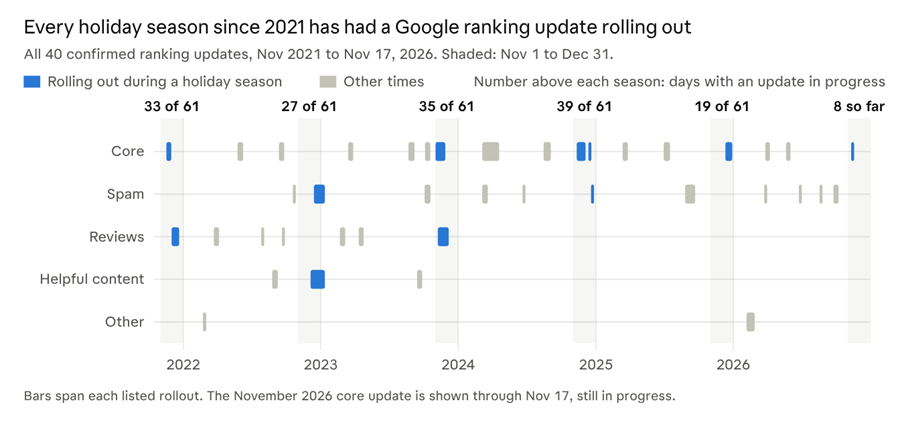
The pace has not been steady. Google confirmed 10 updates in 2022, 9 in 2023, 7 in 2024 and 4 in 2025. With eight in 2026 so far, this year is already twice as busy as last. Spam updates lead this year, with four of the eight, and three were core updates.
Counted by days, the picture is starker. In 2023, an update was rolling out in 135 days, more than a third of the year. Across the full five years, it was about 29% of all days.
And 40 is a floor, not a ceiling. Google’s core updates documentation says it is continually updating its search algorithms, including with smaller core updates that it does not announce because they are not widely noticeable. The dashboard records only the changes Google chooses to confirm.
Why do the holidays keep getting hit?
Because Google has kept shipping updates late in the year. Six of the 40 updates started in December and five in November; only March, with seven, saw more. In four of the five Decembers from 2021 to 2025, at least one new update began; in the fifth, 2023, a review update that started in November was still rolling out until December 7.
The busiest season was 2024. Google ran three updates between November 11 and December 26 that year, including two core updates, and one was in progress on 39 of the 61 days. The quietest was 2025, with a single core update from December 11 to December 29.
The overlap reaches the biggest shopping days, too. Black Friday fell during a rollout in three of the five years from 2021 to 2025: 2021, 2023 and 2024. In each of those years, Cyber Monday did as well. Whether 2026 joins them depends on when the November core update finishes.
None of this means Google is aiming at the holidays. Its dashboard gives no reason for update timing. But for a business, the pattern is clear enough to plan around: there is a good chance rankings will be moving during the weeks it most needs them.
How does the November 2026 core update compare?
Google started the November 2026 core update on November 10, saying it “may take up to 2 weeks to complete.” If it finishes within two weeks, it will end around November 24, three days before Black Friday.
The record suggests treating that as an estimate. Of the 16 core updates before it, half took longer than 14 days. The November 2023 core update took almost 26 days; at that pace, this one would run past Black Friday on November 27 and Cyber Monday on November 30, into early December.
It also ended a long pause. It began 173 days after the May 2026 core update, the third-longest gap between core updates since 2021, after 189 days between November 2021 and May 2022 and 184 days between September 2022 and March 2023. The median gap is 109 days.
Google does not publish a schedule, and a past rollout is not a forecast. It is a reason for businesses to expect rankings to keep moving into the start of the holiday rush, and to judge results only once Google marks the update complete.
What is a core update, and does a drop mean something is wrong?
Google describes core updates as significant, broad changes to its search systems, made several times a year and not aimed at specific sites or pages.
A drop after one does not automatically mean a page has a problem. Google’s documentation, for example, compares it to a list of the best restaurants: when the list is refreshed, a good restaurant can move down because others moved up.
For small movements, such as a page sliding from second to fourth, Google advises against major changes. For large drops that last, it suggests reviewing whether the site’s content is helpful, reliable and written for people rather than for search engines. Spam updates are different: they target sites that break Google’s spam policies, so a business that follows those policies has less reason to worry about them.
How long does an update take to finish?
About two weeks for a core update, and often longer. Across the 16 completed core updates since November 2021, the median rollout took 14.5 days, and half ran past 14 days. The shortest, the December 2024 core update, took about 6 days. The longest, the March 2024 core update, took 45 days.

Other updates vary more. The March 2026 spam update finished in under a day, while the August 2025 spam update ran for nearly 27 days. The December 2022 helpful content update took 38 days, running from early December into mid-January.
This matters because rankings during a rollout are not final. A page that drops on day three may recover by day ten, or the reverse. Updates also overlap: in five cases, two updates were rolling out at the same time, such as the March 2024 core and spam updates, which both started on March 5, 2024. When that happens, a business cannot tell from its own numbers which update moved its rankings.
Google’s own help page for the dashboard notes that when an update is listed, “often, there’s no action needed.”
The practical lesson is patience: wait until Google marks the rollout complete before judging what changed.
What should a business do if its rankings move during the holidays?
Plan for an update rather than react to one. Every holiday season since 2021 has had one, and this year’s is already rolling out. Five steps:
- Check whether an update is running before you change anything. Google lists every ranking update and its status on the Search Status Dashboard. If one is in progress, note the date and wait. Rewriting pages in the middle of a rollout makes it harder to see what actually changed.
- Compare the right dates. Google suggests waiting at least a week after an update finishes, then comparing the week after it with the week before the rollout began. Holiday demand also shifts traffic on its own, so check the same week a year earlier as well; a drop in late December may be the season rather than Google.
- Fix what you control first. Ranking updates do not change your opening hours, phone number or holiday schedule. Make sure your business profiles and listings are accurate, so customers who do find you can act.
- Do not put the whole season on one channel. Email to past customers and short, local paid campaigns keep reaching people while organic rankings settle. A business that relies only on search for its holiday sales takes on the full risk of a mid-season update.
- Review, then act, after the rollout. If a page has dropped sharply and stays down after that comparison, review it against what searchers for that topic need, as Google’s own guidance suggests. That is the point at which search work on a page is worth doing.
Every Google ranking update since November 2021
All 40 ranking updates listed on Google’s Search Status Dashboard, newest first, with the rollout length Google gives for each. The November 2026 core update was still rolling out as of November 17, 2026.
| Update | Type | Started | Rollout length (as listed by Google) |
| November 2026 core update | Core | 10 Nov 2026 | Google: up to 2 weeks |
| September 2026 spam update | Spam | 24 Sep 2026 | 13 days, 16 hours |
| August 2026 spam update | Spam | 18 Aug 2026 | 2 days, 16 hours |
| June 2026 spam update | Spam | 24 Jun 2026 | 2 days, 1 hour |
| May 2026 core update | Core | 21 May 2026 | 11 days, 21 hours |
| March 2026 core update | Core | 27 Mar 2026 | 12 days, 4 hours |
| March 2026 spam update | Spam | 24 Mar 2026 | 19 hours, 30 minutes |
| February 2026 Discover update | Other | 5 Feb 2026 | 21 days, 17 hours |
| December 2025 core update | Core | 11 Dec 2025 | 18 days, 2 hours |
| August 2025 spam update | Spam | 26 Aug 2025 | 26 days, 15 hours |
| June 2025 core update | Core | 30 Jun 2025 | 16 days, 18 hours |
| March 2025 core update | Core | 13 Mar 2025 | 13 days, 21 hours |
| December 2024 spam update | Spam | 19 Dec 2024 | 7 days, 2 hours |
| December 2024 core update | Core | 12 Dec 2024 | 6 days, 4 hours |
| November 2024 core update | Core | 11 Nov 2024 | 23 days, 13 hours |
| August 2024 core update | Core | 15 Aug 2024 | 19 days, 4 hours |
| June 2024 spam update | Spam | 20 Jun 2024 | 7 days, 1 hour |
| March 2024 spam update | Spam | 5 Mar 2024 | 14 days, 21 hours |
| March 2024 core update | Core | 5 Mar 2024 | 45 days |
| November 2023 reviews update | Reviews | 8 Nov 2023 | 29 days |
| November 2023 core update | Core | 2 Nov 2023 | 25 days, 21 hours |
| October 2023 core update | Core | 5 Oct 2023 | 13 days, 23 hours |
| October 2023 spam update | Spam | 4 Oct 2023 | 15 days, 12 hours |
| September 2023 helpful content update | Helpful content | 14 Sep 2023 | 13 days, 11 hours |
| August 2023 core update | Core | 22 Aug 2023 | 16 days, 3 hours |
| April 2023 reviews update | Reviews | 12 Apr 2023 | 13 days, 2 hours |
| March 2023 core update | Core | 15 Mar 2023 | 13 days, 7 hours |
| February 2023 product reviews update | Reviews | 21 Feb 2023 | 14 days |
| December 2022 link spam update | Spam | 14 Dec 2022 | 29 days |
| December 2022 helpful content update | Helpful content | 5 Dec 2022 | 38 days |
| October 2022 spam update | Spam | 19 Oct 2022 | 2 days |
| September 2022 product reviews update | Reviews | 20 Sep 2022 | 6 days |
| September 2022 core update | Core | 12 Sep 2022 | 14 days |
| August 2022 helpful content update | Helpful content | 25 Aug 2022 | 15 days |
| July 2022 product reviews update | Reviews | 27 Jul 2022 | 6 days |
| May 2022 core update | Core | 25 May 2022 | 15 days |
| March 2022 product reviews update | Reviews | 23 Mar 2022 | 14 days |
| Page experience update for desktop | Other | 22 Feb 2022 | 9 days |
| December 2021 product reviews update | Reviews | 1 Dec 2021 | 20 days |
| November 2021 core update | Core | 17 Nov 2021 | 13 days |
Source: Google Search Status Dashboard, Ranking history, accessed November 5 and November 17, 2026; Cirqley compilation.
Not sure where your business stands?
Businesses unsure whether their search presence, listings and campaigns are ready for a holiday update can ask Cirqley for a marketing evaluation.
Methodology
Cirqley compiled every entry on the Ranking history page of Google’s Search Status Dashboard on November 5, 2026, and added the November 2026 core update on November 17, 2026. The page keeps five years of history, so the dataset starts with the November 2021 core update; two entries describing ranking issues rather than updates were excluded, leaving 40 updates. Rollout statistics use the 39 completed updates; the November 2026 core update counts toward days in progress through November 17. Update types follow Google’s own names. A calendar day counts as “in progress” if any part of it falls within an update’s listed rollout, starting from the date Google gives, so counts may differ from exact rollout times by up to a day; the holiday season is November 1 to December 31.